Posts

Showing posts with the label Foreign affairs

India Italy Relations
Image
India and Italy are ancient civilizations but young states (Italy having been reunified only in 1861). These two ancient civilizations have known, interacted and traded with each other for over 2000 years. Modern day contacts between the two nations were formed through exchanges between the intellectuals from both sides. Noble Laureate Rabindranath Tagore visited Italy in1926, on invitation of Carlo Formichi, a Professor of Sanskrit at the University of Rome. Mahatma Gandhi visited Rome in 1931 on his way back to India from the Round Table Conference in London. Leaders of the Indian freedom struggle read the works of the Italian revolutionary Mazzini of early 19th century, who worked for a Democratic Republic of Italy. Indian troops, serving with the British Indian Army, were active in Italy during the World War II. India Italy Political Relations Political relations between India and Italy were established in 1947. The two countries enjoy a cordial relationship. There has bee...

India Russia Relations

Image
Bilateral ties with Russia are a key pillar of India's foreign policy. India views Russia as a time-tested, trustworthy and reliable strategic partner. Since the signing of the ‘Declaration on the India Russia Strategic Partnership’, in October 2000 (during the visit of then President Vladimir Putin to India), there has been a qualitative strengthening of the relationship. During the visit of President Dmitry Medvedev to India in December 2010, it was mutually decided to elevate the bilateral relationship to the level of a “Special and Privileged Strategic Partnership”. The two countries closely cooperate in diverse spheres, including defense, civil nuclear energy, space, science and technology, hydrocarbons, trade and investment, cultural and humanitarian fields. To consolidate and advance multifaceted bilateral ties, several dialogue mechanisms, operating both at the political and official levels, have been instituted to ensure regular interaction and follow up on our coope...

India China Relations

Image
India and China have had ancient civilizational contact. In recent times, the processof development and diversification of bilateral relations has gathered pace. The focus is on enhancing mutually beneficial cooperation while simultaneously addressing differences. India China Political Relations The People s Republic of China (PRC) was established on October 1, 1949, and India was the second non-communist country to recognize it. Within a few months, on April 1, 1950, India and China established diplomatic relations. The two countries also jointly expounded the Panchsheel (Five Principles of Peaceful Co-existence) in 1954. Chinese Premier Zhou Enlai visited India in June 1954 and Prime Minister Nehru visited China in October 1954. The circumstances leading to the attack by China in 1962 led to a serious setback in bilateral relations. India and China restored ambassadorial relations in August 1976. Higher political level contacts were revived by the visit of the then External Af...

India Philippines foreign Relations & Importance

Image
India Philippines Political Defence Relations India and Philippines formally established diplomatic relations on 26 November, 1949, shortly after both countries gained independence, Philippines in 1946 and India in 1947. The relations between the two countries are underpinned by shared values and commonalities such as anti-colonialism, South-South cooperation and the wide use of English; Philippines prides itself as the first democratic country of Asia and India as the largest democracy. During the Cold War, the policies of the two countries were divergent. Despite this, bilateral high level visits kept the relations steady and warm. Prime Minister Indira Gandhi made a stop-over visit to Manila in 1981 on her way back from Australia. President R. Venkatraman paid a state visit to Philippines in 1991.From the Philippines Vice President Diosdado Macapagal visited India in 1961. Starting with the nineties, frequency of summit-level meetings has increased. President Ramos visited India ...

India Kuwait Foreign Relations

Image
Warm and friendly contacts between India and Kuwait go back several centuries and our excellent bilateral relations have been consolidated by the continuous intermingling of our peoples and civilizations. Till the discovery of oil, Kuwait s economy revolved around its fine harbour and three maritime-linked activities, all of which had an Indian perspective: building ships using teak and other timber brought from India; pearl diving and fishing; and voyages to India on dhows carrying dates that were traded for wood, rope, rice, tiles, cloth and spices. Until 1961, Indian Rupee was the legal tender in Kuwait. The Kuwaiti ruling family too has had longstanding ties with India. Cultural affinities, historical trade and other linkages, geographic proximity, and a large presence of Indian expatriates in Kuwait, have sustained and nurtured the close relationship, which encompasses significant political, trade and economic interests. VVIP visits from India to Kuwait: These have been by H...

Indian New Zealand Relations

Image
India- New Zealand have traditionally enjoyed cordial and friendly relations based on common linkages of Commonwealth, parliamentary democracy, English language and sports. Agreements Signed : Trade Agreement - October 1986 Agreement on avoidance of Double Taxation - October, 1986 Civil Aviation Agreement between India and New Zealand August 1997 MOU on Scientific and Technical Cooperation between ICAR and Horti Research of New Zealand - March 1998 MoU of Technical Cooperation between Department of Agriculture and Cooperation, Ministry of Agriculture, GOI and Ministry of Agriculture and Forestry Regulatory Authority of New Zealand on Cooperation on Plant Quarantine Issues, April 1999 Arrangement between India and New Zealand for cooperation in the area of Information Technology, December 2001 MoU between Indian Institute of Carpet Technology (IICT) and the Wool Research Organisation of New Zealand (WRONZ), May 2003 MOU on Cooperation between the Indian Co...

Indian Foreign Services

The origin of the Indian Foreign Service can be traced back to the British rule when the Foreign Department was created to conduct business with the “Foreign European Powers”. In fact it was on September 13, 1783, when the Board of Directors of the East India Company passed a resolution at Fort William, Calcutta (now Kolkata), to create a department, which could help “relieve the pressure” on the Warren Hastings administration in conducting its “secret and political business”. Subsequently known as the “Indian Foreign Department”, it went ahead with the expansion of diplomatic representation, wherever necessary, to protect British interests. In 1843, Governor-General Ellenborough carried out administrative reforms under which the Secretariat of the Government was organized under four departments – Foreign, Home, Finance and Military. Each was headed by a Secretary level officer. The foreign department Secretary was entrusted with the “conduct of all correspondence bel...

India Switzerland Bilateral Relations

Image
Switzerland and India have had cordial and friendly relations since India became independent. The relationship is based on shared values of democracy, multiculturalism and the rule of law. Independent India’s policy of non-alignment and Switzerland’s traditional policy of neutrality helped to develop a close understanding between the leaders of the two countries in the early years. A Treaty of Friendship between India and Switzerland was signed at New Delhi on August 14, 1948, one of the first such treaties to be signed by the independent India. The Treaty provided for the establishment of diplomatic missions between the two countries and diplomatic missions were opened in Berne and Delhi soon after its conclusion. During the course of 2008, India and Switzerland celebrated the 60th anniversary of the signing of the Friendship Treaty, an important milestone in the annals of our bilateral relations. In recognition of the growth of multi-faceted bilateral relationship in the past six...

India Singapore Relations

 India Singapore Political Relations India and Singapore have a cordial relations and bilateral relationship based on convergence of strong economic and political interests. The process of economic growth and economic reforms in India since the early 1990s created a strong basis for cooperation with Singapore, opening up possibilities for significant presence in each others’ economies. For India, Singapore has also played an important role in reconnecting us to the countries of South East Asia and beyond. As pluralistic societies, the two nations share similar concern about the challenges posed by terrorism and religious extremists and have therefore found it mutually beneficial to evolve a broad framework of security cooperation. Singapore, led by then PM Goh Chok Tong, took a major interest in India’s economic reforms in the 1990s. He visited India in 1994 as the Chief Guest at our Republic Day celebrations. A reciprocal visit by PM Shri Narasimha Rao took place in September ...

India - Pakistan Joint statement after the meeting between the Foreign Secretaries

Image
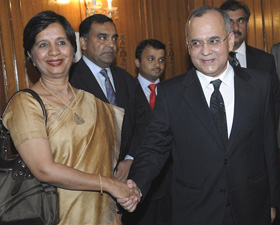
Under the resumed dialogue process, the Foreign Secretaries of Pakistan and India met in Islamabad, on 23-24 June 2011 for bilateral talks on Peace and Security including CBMs, Jammu and Kashmir and promotion of friendly exchanges. Three sessions of talks were held. 2. The talks were held in a frank and cordial atmosphere. Both sides reiterated their intention to carry forward the dialogue process in a constructive and purposeful manner. 3. The issues of Peace and Security, including CBMs, were discussed in a comprehensive manner. Both sides emphasized the importance of constructive dialogue to promote mutual understanding. 4. They noted the ongoing implementation of various Nuclear and Conventional CBMs. They also decided to convene separate Expert level meetings on Nuclear and Conventional CBMs to discuss implementation and strengthening of existing arrangements and to consider additional measures, which are mutually acceptable, to build trust and confidence and promote peace a...